Overview
please respond to Adam with 140. words
Printing pictures were developed in China by the ninth century from woodblock matrices. In the eleventh century, movable type was invented by the Chinese. Meanwhile, Printmaking developed in Europe during the fifteenth century, which was done initially to reduce the costs of religious images and playing cards before being used to illustrate books printed with European movable type.
Relief prints involve the cutting of the printing surface to create the matrix, taking on forms such as woodcuts or linocut. Woodcut printing is the carving of a plank to create an image, and linocut similarly carves the surface of linoleum, a rubbery, synthetic material. Opposite of relief printing is intaglio printing, where the image on the matrix is cut before being reversed on a sheet of paper to be printed. Engraving can be done on either a wooden or metal surface, and it generally requires appropriate tools to carve smooth, precise lines. The more difficult technique of drypoint is like engraving in the sense that it involves the use of a pointed tool to scratch onto a metal plate, though it catches the ink to leave blurred lines. Etching, too, needs the use of a metal tool to penetrate the surface, allowing for freedom to be incorporated in the drawing. However, in lithography, there is no necessity to cut the matrix; instead, the image can be drawn on the surface using litho tools to translate the image onto a piece of paper. Finally, stencils are extremely useful to trace or paint various designs in an efficient manner, and screenprinting, an advancement to stencil printing, replicates an image without the need for reversal, making it an easy candidate for mass-produced editions.
A print is an artwork existing in multiple copies and created from a matrix materialized in the form of metal, wood, or stone. Throughout the development of a print, an artist may prefer to leave proofs to check its progress, and when they become satisfied with the print, they can choose to leave an AP mark, or artist's proof. Prints may be created to act as cheaper alternative to paintings and sculptures for consumption, promote social causes, or simply for the love of printmaking.
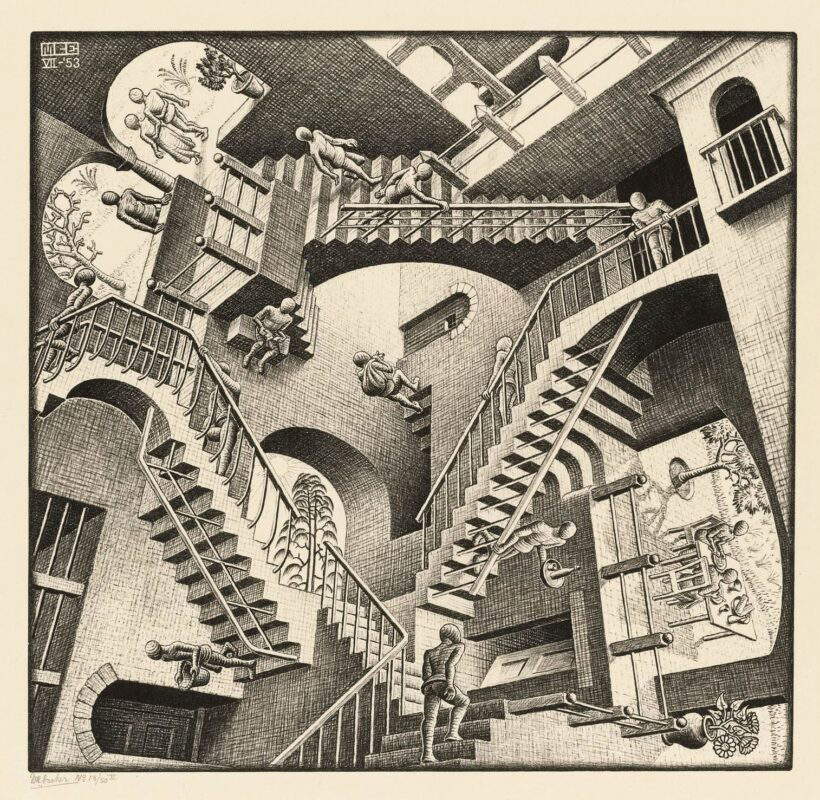
M.C. Escher, RELATIVITY.
1953. Lithography.