Case Study: Just for FEET, Inc.
For this case study, you will be required to apply course concepts and analytical tools to analyze acts of theft, identify symptoms of fraud, and demonstrate an understanding of the investigative process.
First, read the Just for FEET, Inc. case in MindTap that is linked in the Unit Materials section of this unit. Note: You are not required to answer the questions listed at the end of the case study in MindTap. Begin your case study as follows:
- Briefly explain the significance of fraud in the context of corporate governance and financial malfeasance.
- Summarize the Just for FEET, Inc. fraud scandal.
- Identify key events and individuals involved.
- Correlate the elements of the fraud triangle to this case.
- Identify of the elements of fraud in this case.
Next, organize your case study analysis into five parts as follows:
Part 1: In this part you will identify and analyze specific theft acts that occurred in the Just for FEET, Inc. scandal. Focus on fraudulent activities related to accounting, financial reporting, or other pertinent areas.
Begin by preparing a balance sheet and income statement for Just for Feet, Inc. for the period 1996–1998. Also compute key liquidity, solvency, activity, and profitability ratios for 1997 and 1998. Then, address each of the following:
- Given these data, what do you believe were the high-risk financial statement items for the 1998 Just for Feet audit?
- What were the specific fraudulent actions undertaken by individuals involved in the scandal?
- Explain how financial records were manipulated to conceal the theft acts?
- Explain how revenues were manipulated within the company's financial statements.
- Identify any instances of fraudulent expense reporting or financial statement manipulation?
Part 2: Explore other potential red flags that could have indicated the presence of fraud within Just for FEET, Inc., such as:
- Anomalies in inventory management or valuation
- Employee behavior (i.e., sudden lifestyle changes, resistance to internal controls)
Part 3: Describe the investigative methods that could have been employed to uncover fraud in its initial stages.
- What forensic accounting techniques could have been applied to detect financial irregularities?
- How could internal and external auditors have conducted more effective investigations?
Part 4: Determine how the fraud was detected and proven during the subsequent investigative process. Explore the role of auditors, internal controls, and other financial oversight mechanisms involved.
- How did the company's internal and external auditors respond to the accounting irregularities?
- Were there deficiencies in the company's internal controls that contributed to the perpetuation of the fraud?
Part 5: Reflect on the lessons learned from the Just for FEET, Inc. fraud scandal.
- Propose comprehensive preventive measures and best practices for future fraud prevention.
- Include at least one data-driven detection method or technology.
- How can organizations create a culture that encourages early reporting of suspicious activities?
- What internal controls and monitoring systems should be implemented to prevent similar frauds?
The written response portion of your case study must be at least three pages in length, but no more than four pages in length. This requirement does not include the title page (if used), references page, or Part 1 calculations. The balance sheet, income statement, and ratio calculations from Part 1 must be inserted as Appendix A, following your written responses.
You are required to use a minimum of four peer-reviewed, academic, or industry reliable sources to support your case study analysis, one of which may be your course eTextbook. Wikis, blogs, and other opinion-based sources may not be used. At least one source must come from the CSU Online Library. All sources used must have citations and references properly formatted in APA Style.
----------------------------------------------------------------------------------------------------
----------------------------------------------------------------------------------------------------
What Does Fraud Look Like in Your Area?
This one-page infographic assignment measures your mastery of ULOs 1.5 and 5.1 and is worth 10% of your course grade.
For this assignment, you will need to investigate the various types and rates of occurrence of occupational and consumer fraud in your area. You will then create a one-page infographic to represent your findings. You may choose to focus your infographic on your current state or, if enough data is available, your city, county, or local community. Do not focus your infographic on overall U.S. data or statistics.
Your infographic should be constructed to illustrate the most recent and important statistics or information you uncover regarding the prevalence and types of occupational and consumer fraud in your area. The infographic should provide the reader with an at-a-glance synopsis of your findings. Because space is limited, your goal is to present the information in a way that captures the reader’s attention and drives home that fraud can affect any of us, anywhere.
Your infographic should illustrate concepts covered in this unit’s learning materials and address the prevalence, types, and ramifications (i.e., financial, personal, ethical, legal) of both occupational or fraud and consumer fraud.
Utilize creativity to design your infographic, but ensure it is well organized and readable. Keep the text succinct and use images in a size and manner that do not distract from the message. The following examples may help provide design inspiration:
- A Scammy Snapshot of 2023 (FTC, 2024)
- Consumer Sentinel Network Data Book 2023 Snapshot (FTC, 2023)
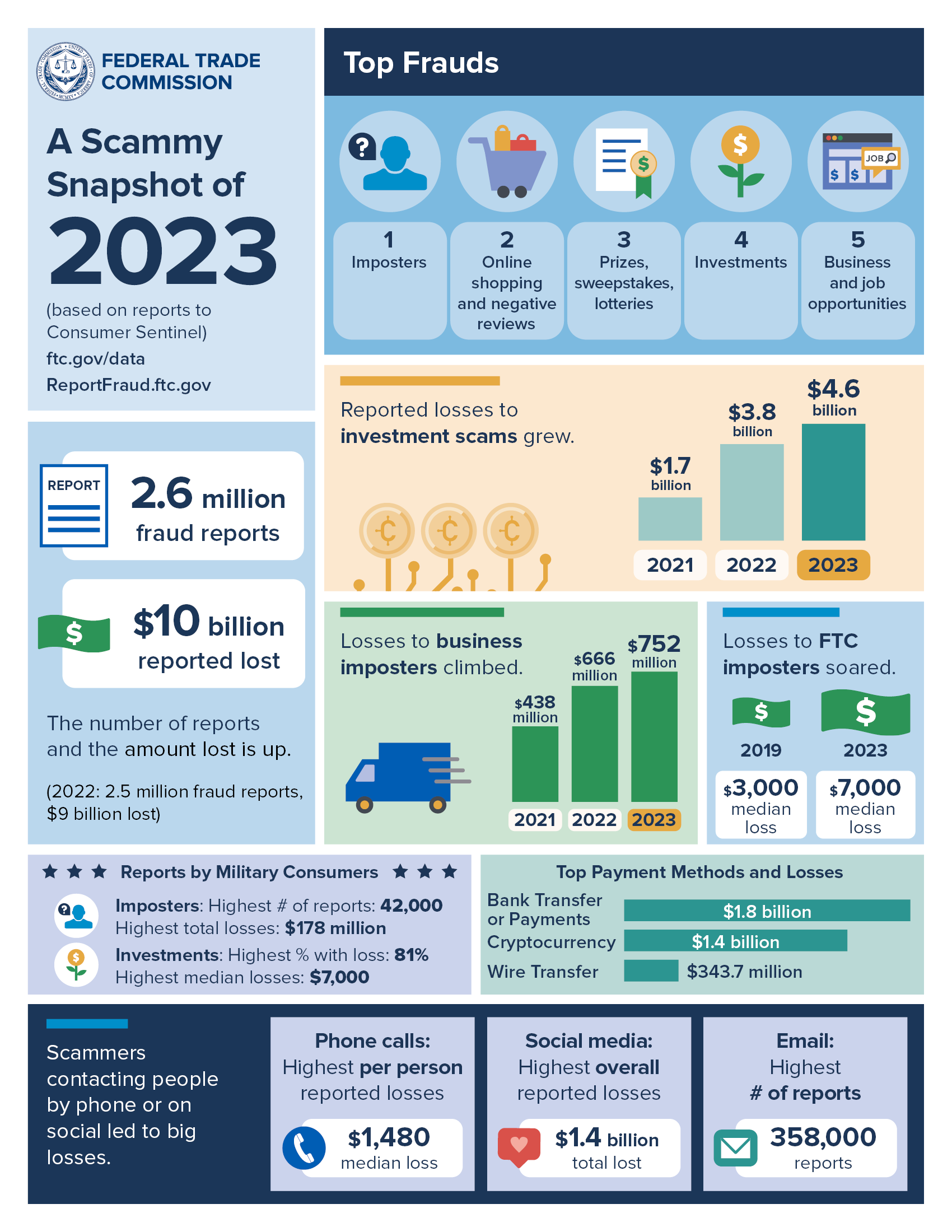
There are many free resources that can help you create your infographic. Adobe Express, Canva, Miro, and even PowerPoint all offer infographic templates you can customize.
Once you have developed your infographic, save it as an image and insert it into a Word document. All sources used to develop your infographic should have in-text citations; references should be properly formatted in APA Style on a separate page.
--------------------------------------------------------------------------------------------------
--------------------------------------------------------------------------------------------------
Financial Fraud at Austal USA
For this journal, you will provide your own analysis and opinions in a two-page case study of the fraud investigation at Austal USA and of three of its former executives. This journal measures your mastery of ULOs 5.2 and 5.3 and is worth 8% of your course grade.
Austal USA is an American shipbuilder Mobile, Alabama. It is a wholly owned subsidiary of Austal Limited, an Australian company that is traded over the counter in the United States, as well as on the Australian Securities Exchange.
Craig Perciavalle, Joseph Runkel and William Adams, former executives of Austal USA, were indicted in 2023 by the Department of Justice (DOJ) on criminal charges related to an accounting fraud scheme. The Securities and Exchange Commission (SEC) has also filed a twin, civil complaint related to the same alleged fraud. The scheme involved falsely overstating revenue that Austal USA was earning from shipbuilding contracts with the U.S. Navy. The three men are alleged to have conspired to mislead Austal’s shareholders and the investing public about the company’s financial condition. This artificially boosted the stock price and led to a write-down of over $100 million in previously wrongly booked profits.
After conducting your own further research on the Austal USA case, you will construct a case study summarizing the factors in the DOJ and SEC cases against Austal USA, Perciavalle, Runkel, and Adams.
Next, explore the distinctions between the civil and criminal cases of fraud at Austal USA by addressing each of the following:
- Compare and contrast the basic differences between a criminal case and a civil case for the same fraud. Include burden of proof, legal standards, and objectives of civil and criminal proceedings. Address how the same actions may lead to both civil and criminal consequences concurrently.
- Discuss how the alleged fraudulent actions may meet the criteria for civil fraud, emphasizing misrepresentation, materiality, and damages.
- Discuss how the alleged fraudulent actions indicted may fulfill the conditions for criminal fraud, focusing on intent, false representation, and knowledge of wrongdoing.
- Explore potential civil and criminal consequences for including additional lawsuits, sentences, and financial penalties.
- While the three executives are specifically named in the indictments, do you think Austal USA as an organization bears any liability and should be charged separately Explain your rationale.
Finally, if you were the lead fraud investigator in this case or if you were called as an expert witness in either the civil or criminal cases, identify and justify your top three priorities in ensuring your conduct adheres to strict ethical fraud examination standards to promote justice and fairness in the legal arena.
Your journal submission must be at least two pages, but no more than three pages in length. You must use at least two sources to support your analysis. All sources used must have citations and references properly formatted in APA Style.