Step 1: Watch a video on the Law Code Stela of HammurabiLinks to an external site.
Answer the following questions: (1-2sentences each)
1. On the Stela, the god Shamash gives the laws to Hammurabi. Visually, how do we know Shamash is a god?
2. Why would Hammurabi want the stela to have both pictorial and written components?
Step 2: Read an English translation of the cuneiform writing on the SteleLinks to an external site.. You only need to read laws #3, 6, 196, 197, 229, 230, 231.
Answer the following questions: (1-2 sentences each)
3. How does the image at the top of the stele relate to the law code below?
4. What is Shamash's position and size in comparison to Hammurabi? What does this tell the viewer about their relationship? (3 points)
5. In reading laws #3, 6, 196, 197, 229, 230, 231, how does justice work under Hammurabi's law code? (3 points)
Previous
Next
Law Code Stele of King HammurabiArtwork Details[Image unavailable: Downward pointing arrow]Law is at the heart of modern civilization, and is often based on principles listed here from nearly 4,000 years ago.
Law Code Stele of King Hammurabi, basalt, Babylonian, 1792–1750 B.C.E. (Musée du Louvre, Paris)
Video transcript
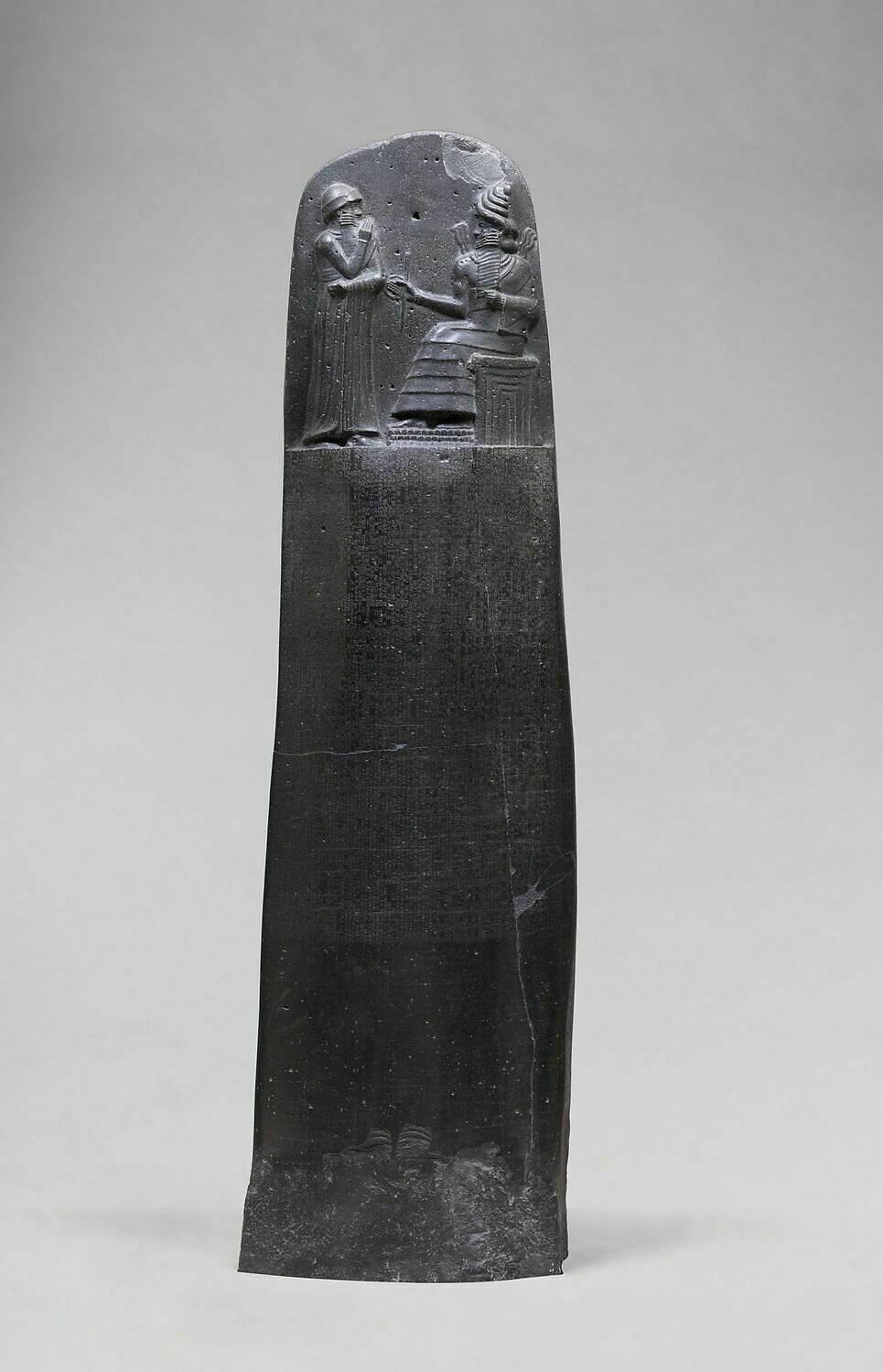
Law Code Stele of King Hammurabi, basalt, Babylonian, 1792–1750 B.C.E. (Musée du Louvre, Paris)
Hammurabi of the city-state of Babylon conquered much of northern and western Mesopotamia and, by 1776 B.C.E., he was the most far-reaching leader of Mesopotamian history, describing himself as “the king who made the four quarters of the earth obedient.” Documents show Hammurabi was a classic micro-manager, concerned with all aspects of his rule, and this is seen in his famous legal code, which survives in partial copies on this stele in the Louvre and on clay tablets. We can also view this as a monument presenting Hammurabi as an exemplary king of justice.
What is interesting about the representation of Hammurabi on the legal code stele is that he is seen as receiving the laws from the god Shamash, who is seated, complete with thunderbolts coming from his shoulders. The emphasis here is Hammurabi’s role as pious theocrat, and that the laws themselves come from the god.
Step 1: Watch a video on the Law Code Stela of HammurabiLinks to an external site.
Answer the following questions: (1-2sentences each)
1. On the Stela, the god Shamash gives the laws to Hammurabi. Visually, how do we know Shamash is a god?
2. Why would Hammurabi want the stela to have both pictorial and written components?
Step 2: Read an English translation of the cuneiform writing on the SteleLinks to an external site.. You only need to read laws #3, 6, 196, 197, 229, 230, 231.
Answer the following questions: (1-2 sentences each)
3. How does the image at the top of the stele relate to the law code below?
4. What is Shamash's position and size in comparison to Hammurabi? What does this tell the viewer about their relationship? (3 points)
5. In reading laws #3, 6, 196, 197, 229, 230, 231, how does justice work under Hammurabi's law code? (3 points)
Previous
Next