Overview
1.
The graph of f '(x) is continuous, positive, and has a relative maximum at x = 0. Which of the following statements must be true? (5 points)
The graph of f is always concave down.
The graph of f is always increasing.
The graph of f has a relative maximum at x = 0.
The graph of f has a relative minimum at x = 0.
2.
Below is the graph of f '(x), the derivative of f(x), and has x-intercepts at x = -3, x = 1, and x = 2 and a relative maximum at x = -1.5 and a relative minimum at x = 1.5. Which of the following statement is false?
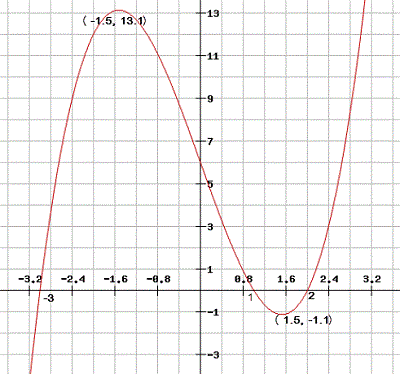 (5 points)
f is concave up from x = -1.5 to x = 1.5.
f has an inflection point at x = 1.5.
f has a relative minimum at x = 2.
All of these are false.
3.
The graph of y = f '(x), the derivative of f(x), is shown below. List the intervals where the graph of f is concave down.
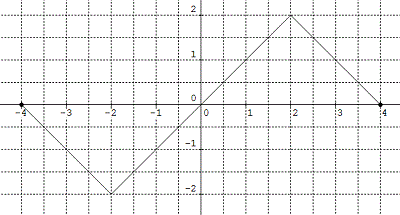 (5 points)
(-4, -2) U (2, 4)
(-2, 2)
(-4, 0)
(0, 4)
4.
Which of the following functions grows the fastest as x grows without bound? (5 points)
f(x) = ex
g(x) = ecosx
h(x) = 
They all grow at the same rate.
5.
Compare the growth rate of the functions f(x) = x3 + 1 and g(x) = x2 . (5 points)
f(x) grows faster than g(x).
g(x) grows faster than f(x).
f(x) and g(x) grow at the same rate.
It cannot be determined.
6.
f is a function that is differentiable for all reals. The value of f '(x) is given for several values of x in the table below.
x-8-3038f '(x)-4-2045
If f '(x) is always increasing, which statement about f(x) must be true? (5 points)
f(x) passes through the origin.
f(x) is concave downwards for all x.
f(x) has a relative minimum at x = 0.
f(x) has a point of inflection at x = 0.
7.
f is a differentiable function on the interval [0, 1] and g(x) = f(2x). The table below gives values of f '(x). What is the value of g '(0.1)? (5 points)
x0.10.20.30.40.5f '(x)123-45
1
2
4
Cannot be determined
8.
Use the graph of f(t) = 2t + 2 on the interval [-1, 4] to write the function F(x), where 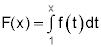 . (5 points)
F(x) = x2 + 3x
F(x) = x2 + 2x - 12
F(x) = x2 + 2x - 3
F(x) = x2 + 4x - 8
9.
The velocity of a particle moving along the x-axis is v(t) = t2 + 2t + 1, with t measured in minutes and v(t) measured in feet per minute. To the nearest foot find the total distance travelled by the particle from t = 0 to t = 2 minutes. (5 points)
10.
Find the range of the function 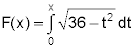 . (5 points)
[-6, 6]
[0, 6]
[0, 9?]
[0, 18?]