Overview
Required
- Chapters 7-9, 11 & 14 in Key Concepts in Public Health
- Kouzes, J., & Posner, B. (2015). The five practices of exemplary leadership model. Retrieved from http://www.leadershipchallenge.com/about-section-our-approach.aspx
Recommended
- Otto, J., Holodniy, M., & DeFraites, R. F. (2014). Public health practice is not research. American Journal of Public Health, 104(4), 596-602. doi:10.2105/AJPH.2013.301663
- Pobric, A., & Robinson, G. (2015). Population ageing and low fertility: Recent demographic changes in Bosnia and Herzegovina. Journal of Population Research, 32(1), 23-43. doi:10.1007/s12546-014-9141-5
POST1:
Denver's metro population grew by 1.53% from 2017 to 2018, with 44,188 new residents, according to population estimates released by the U.S. Census Bureau (2018). The metro's total population for 2018 was 2,932,415. Denver remains the 19th-largest metro in the U.S., just behind Tampa. Over the past eight years, the Denver metro has also seen rapid growth. From 2010 to 2018, its population grew 15.3%. Meanwhile, between those years, Denver County's population grew by about 19%. The state of Colorado is the second-fastest-growing state in the U.S., driven in large part by growth in the Denver metro area. The most common ancestry groups in Denver are Mexican (31.2%), German (14.6%), Irish (9.7%), English (8.9%), and Italian (4.0%). 23.5% of Denver's population speaks Spanish at home (Census.gov, 2019).
21.5% of Denver's population is under 18, while 10.7% are 18-24, 36.1% are 25-44, 20% are 45-64, and 10.4% are 65 or older, with a median average of 37 years. The city's growth is credited to the ongoing development of areas like Stapleton, the buildout of the area's few remaining greenfield areas, and a great deal of densification in the urban area. Denver is now the fastest growing city in the United States overall, and also first among large metro areas for population gain in the 25-34-year age group. Denver shows net migration in 2013 of close to 17,000, with an employment growth rate of 2.0%. Denver will continue to remain an attractive area to new residents through migration, and it is estimated the city will reach 700,000 and beyond by 2020. The full metro area is projected to reach 4.1 million by 2040, according to projections from the state demographer (United Nations, 2018). [Image unavailable: Screen Shot 2019-10-25 at 5.50.41 PM.png]
[Image unavailable: Screen Shot 2019-10-25 at 5.49.31 PM.png]
Being I have only lived in Denver for almost two years now, where I currently live, which is right within Denver city limits, show rapid growth with new developing properties, mostly housing. Being a transplant myself, there is a sense of not being welcomed by many Colorado natives as the growth in population has added frustrations to the cost of living with rent increases, and traffic. A few years ago, it was said that the influx in more people moving here was the legalization of cannabis, but I do not find that true currently as many states now have legalized cannabis. However, with the relative access to many forms of cannabis, with increased population, perhaps also increases the use, especially with vaping products. Not to mention that traffic has risen dramatically, causing more cars on the road, more smog, more accidents, and more time people are spending in their cars than with friends and family, enjoying a work-life balance.
Reference
U.S. Census. (2019). Denver region. Retrieved from https://www.census.gov/programs-surveys.html
United Nations. (2018). Denver populations. Retrieved from http://worldpopulationreview.com/us-cities/denver-...
POST2:
I saw that someone had already done data on Denver, so I will use Fort Collins.
The average age for Fort Collins is 29.2, I would attribute this to the fact the Fort Collins is the home of Colorado State University (CSU). The 2017 Demographic Estimate states that in Fort Collins 339,400 are males and 339, 067 are females. 521,481 are White, 64,466 Asian, 993 Hawaiian or Pacific Islander, 6,537 Native American, 64.466 Black or African American, and 207, 100 Hispanic or Latino. As of 2010, the population was 143,986 but the estimate for July 1, 2018 is 167,830 (US Census, 2019). With a large jump in population I would assume that it has something to do with the close proximity to Denver Metro, and perhaps the cost of living.
CSU (2018) put out a Financial Considerations sheet for graduate students planning on moving to Fort Collins. The sheet compared Fort Collins to other major cities where universities reside in the United States.The sheet says "Cost of living indices are based on a U.S. average of 100. An amount below 100 means the city is cheaper than the U.S. average; whereas a cost of living index above 100 means a city is more expensive." Fort Collins indices is 124.20, with the cheapest city being Baltimore, MD at 90.00 (Colorado State University, 2018). CSU also provided several resources for graduate students to be able to determine the cost of living in comparison to other cities, one of them is the website SmartAsset which provides calculators to compare two different cities. I typed in Fort Collins and Denver to see what the differences are for a single adult with no children making $40,000 a year.
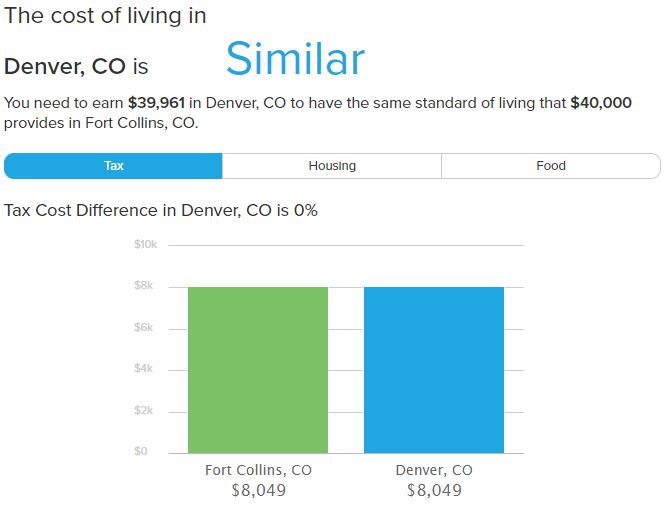
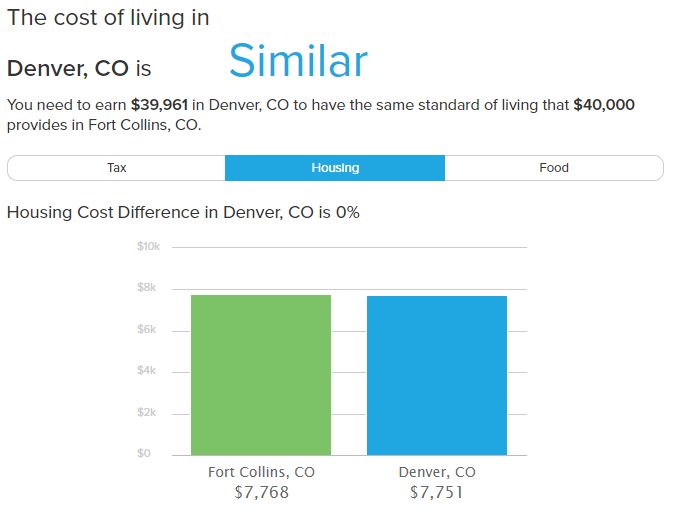
(SmartAsset, 2019)
As we can see, there is really not much of a difference between Denver and Fort Collins, however I am curious if it has something to do with a healthier lifestyle. Fort Collins is known as a "granola" town by us natives. A city in which people are active, ride their bikes to work, climb 14ers on their weekends and abide by a plant based diet. According to the Coloradan (2015), Fort Collins was named one of the country's top ten healthiest cities by Liveability, the only Colorado city to be named at number nine. The criteria that helped Fort Collins to make this list include the amount of farmers markets, hiking trails, strong bike culture, the amount of adult obesity, and environmental components such as air and water quality (Meyers, 2015). I feel that this goes back to our previous lessons on making cities healthier by providing an all inclusive living area. With my topic of obesity, I feel that Fort Collins is an excellent example of creating an environment where healthy is the "cool" thing to be and promotes an active lifestyle.
Selene
Colorado State University. (2018, May). Financial considerations for graduate students. Retrieved from http://www.engr.colostate.edu/sbme/wp-content/uploads/2018/05/Financial-Considerations-for-Graduate-Students.pdf (Links to an external site.)
Meyers, Stephen. (2015, April 6). Fort Collins top healthy city. Retrieved from https://www.coloradoan.com/story/sports/outdoors/2015/04/06/fort-collins-top-healthy-city/25358795/ (Links to an external site.)
SmartAsset. (2019). 2019 Cost of living calculator. Retrieved from https://smartasset.com/mortgage/cost-of-living-calculator#VuJ58LxlsN (Links to an external site.)
United State Census Bureau. (2019). Fort Collins, Colorado. Retrieved from https://factfinder.census.gov/faces/nav/jsf/pages/community_facts.xhtml