Overview
I need help with a Geology question. All explanations and answers will be used to help me learn.
Please reply to both POST1: and POST2: in at least 150 words each
Initial post:
We use what we know about Earth, its structure, atmosphere, geologic activities, and processes to prove or disprove our theories of other planets. For example, we used Google Earth in Week Four’s lab to examine rivers on Earth, and then will apply what we know of Earth’s rivers to explore evidence for past rivers on Mars in this week’s lab. Describe one other such example of our usage of Earth analogs to determine the circumstances elsewhere and how it might influence our extraplanetary explorations in the future. And for the last time this term, don’t choose one that has already been posted.
POST1:
Space exploration is a much-debated issue where some believe it is a waste of money that should be used for the sustainability of Earth; whereas, others believe exploring the solar system is one of the noblest pursuits of man. If we look at space exploration, it is possible that scientists will find new minerals and resources that would benefit our investment in the future. History has allowed man to understand the inner workings of Earth, how it is continually changing, and using this knowledge to preserve the planet.
There was time when astronomers assumed Mar's surface was like Earth's surface, and capable of supporting life. Earth's atmosphere consists of a mixture of gasses, called air; in fact, the atmosphere has four layers. The only planet in the solar system that is capable of sustaining life is Earth, because there is a blanket of gases that provide breathable air and protects us from the sun's heat and radiation. Understanding the atmospheric conditions leads us to fully understand how Mar's and Venus's atmospheric conditions would provide life supporting measures.
Mar's is mostly a carbon dioxide atmosphere, with traces of nitrogen, argon, oxygen, carbon monoxide, and other gases. According to Tim Sharp (2017), Mar's atmosphere is about 100 times thinner than Earth's.
By continuing to learn and develop a greater understanding of Earth's structure, composition, and geological events, scientists will be able to apply this knowledge to discovering whether a new planet is capable of sustaining life. Even though we man not have graduated to this stage, scientists are accepting the challenge.
"We choose to go to the Moon!...We choose to go to the Moon in this decade and do the other things, not because they are easy, but because they are hard; because that goal will serve to organize and measure the best of our energies and skills, because that challenge is one that we are willing to accept, one we are willing to postpone, and one we intend to win." John F. Kennedy.
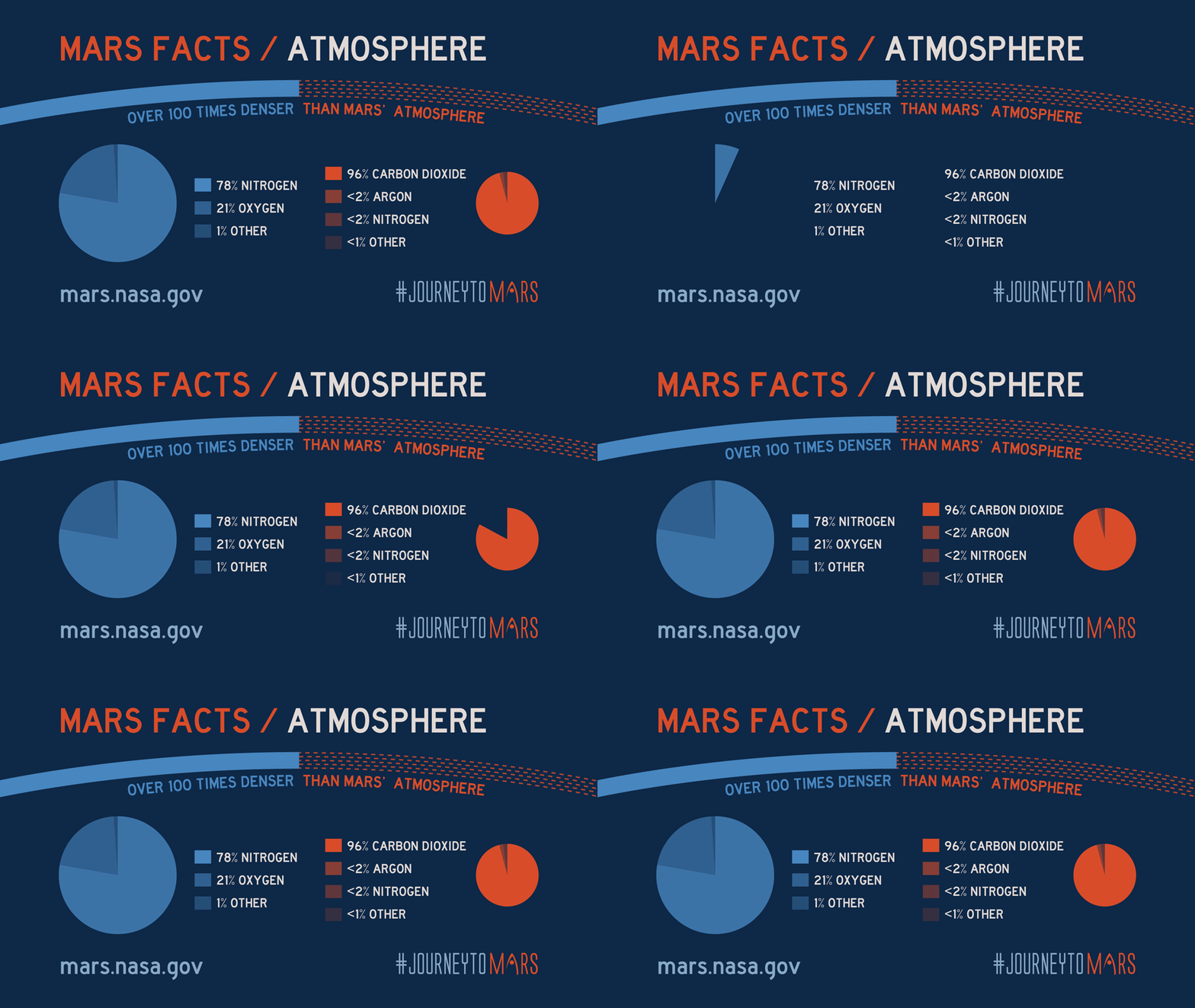
Figure 1. NASA Science Mars Facts. (https://mars.nasa.gov/all-about-mars/facts/
NASA. (n.d.). NASA Science Mars Facts. Retrieved from https://mars.nasa.gov.all-about-mars/facts/ (Links to an external site.)
Sharp, T. (2017, October 13). Earth's Atmosphere: Composition, climate & Weather. Retrieved from https://space.com/17683-earth-atmosphere.html (Links to an external site.)
Williams, M. (2015, June 4). Universe Today. Retrieved from https://universetoday.com/111462/how-cna-we-live-o...
POST2:
Ocean exploration is a area that has been on the rise as engineers seek to understand the hidden treasures below the surface or if life exist or can exist. Similar to what NASA has done for years on the moon, there is a desire to discover beyond the earth crust if life interfaces at sea bottom and ice-water interface at the top of the ocean. Scientists like Kevin Hand, JPL lead scientist on the BRUIE project, believe that these lunar oceans, such as those on Jupiter's moon Europa and Saturn's moon Enceladus, may be the best places to look for life in our solar system. Bartels (2019). We know that the earths ocean took millions of years to form and that the water and other gases boiled off space ultimately formed rain and eventually formed the oceans basins. To understand this concept is to also understand factors like world rotation, thickness of ice shells and the density of seawater and how this water moves around the ocean. The expedition of exploring the ocean covered by ice requires a underwater rover called a BRUIE. I Bartels (2019)t was designed and tested by NASA engineers. It is said that the earth Arctic is simpler to explore than the moon which is 600 million miles away.
What we know about Earth, its structure, atmosphere, geologic activities, and processes makes exploring what’s going on benefit the surface makes this research just as interesting. Biologists have long speculated that life on Earth began in the oceans. Sato,(2009). The primary goal of a expedition like this is to understand ocean dynamics, its habitability how you get nutrients from one place to another place, how you move energy from one place to another place and how we use technology and expertise needed to explore the ice-covered ocean. Robots under water appear to be the answer.
Reference
Bartels, Meghan, 2019 NASA's Undersea Robot Crawls Beneath Antarctic Ice in Test for Icy Moons Retrieved from https://www.space.com/underwater-rover-testing-for-icy-moons.html (Links to an external site.)
Sato, Taichi, 2009, Toward Extraplanetary Under-Ice Exploration: Robotic Steps in the Arctic retrieved from https://deepblue.lib.umich.edu/bitstream/handle/2027.42/62066/20288_ftp.pdf?sequence=1