Overview
Question 1 (6 points)
a. Label the reactants and the products in the following chemical equation. (1 point)
CH4 + 2O2  CO2 + 2H2O
b. Describe how the balanced chemical equation above illustrates the law of conservation of matter. (1 point)
c. How do an endothermic reaction and an exothermic reaction differ? (1 point)
d. Sort the examples below into endothermic reactions and exothermic reactions. (1 point)
Examples: cooking eggs, photosynthesis, burning a candle, using an instant cold pack, using a chemical hand-warmer, car engine
Endothermic reactions
Exothermic reactions
e. In the space below, draw a potential energy diagram for an endothermic reaction and a second potential energy diagram for an exothermic reaction. Give each graph a title, and label the reactants and products on each graph. (2 points)
Question 2 (7 points)
a. What field of physics involves studying heat, work, and energy? (1 point)
b. A system can be classified as open, closed, or isolated, based on whether matter and energy can enter and exit. Complete the table by writing Yes or No in each box. (1 point)
Open systemClosed systemIsolated systemCan matter enter and exit? Can energy enter and exit?
c. What is the mathematical equation for the first law of thermodynamics? Identify each variable in the equation. (1 point)
d. Fill in the blanks in the following paragraph to correctly identify the signs associated with heat and work. (1 point)
When a system is heated, heat is _______________ by the system. The amount of heat added is given a _______________ sign. When a system is cooled, heat is _______________ by the system. The amount of heat is given a _______________ sign. If a gas expands, it must push the surrounding atmosphere away. Thus, work is done _______________ the system and is given a _______________ sign. If a gas is compressed, then work is done _______________ the system. This work is given a _______________ sign.
e. What is the change in internal energy if 50 J of thermal energy are released from a system, and the system does 80 J of work on its surroundings? (1 point)
f. Describe the conditions needed for a process to be isobaric. (1 point)
g. What is special about an adiabatic process? (1 point)
Question 3 (5 points)
a. Fill in the blanks in the following paragraph to correctly identify four principles of the second law of thermodynamics. (1 point)
Heat naturally flows from an object that has a _______________ temperature to an object that has a _______________ temperature. Heat can be made to flow in the reverse direction if _______________ is done. A machine can never have an efficiency of _______________. This means that heat energy can never be fully converted into _______________ energy.
b. Describe entropy. What is the natural tendency of the entropy of a system? (1 point)
c. How does a heat engine differ from a heat pump? (1 point)
d. What is the efficiency of a device that takes in 600 J of thermal energy and does 300 J of work? Use  . (1 point)
e. The graph below shows a cycle of a heat engine. Add the following labels to the graph. Some labels are used more than once. (1 point)
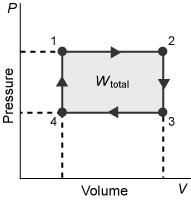
Labels: Isobaric process; W = 0 J; Work done on the system; Work done by the system
Question 4 (3 points)
a. Match the term to its correct description. (1 point)
A. Convection B. Radiation C. Thermal conductor D. Thermal insulator E. Conduction
_____ A substance that transfers heat poorly
_____ Heat transfer through direct contact of particles
_____ Heat transfer through motion of a fluid
_____ Heat transfer through electromagnetic waves
_____ A substance that transfers heat well
b. A physics student is sitting at the beach. She feels the warm Sun shining on her back, the warm sand under her feet, and a cool breeze blowing in from the water. Identify each type of heat transfer she is experiencing. (1 point)
c. How do particle motion and temperature change as a material absorbs heat? (1 point)
Question 5 (4 points)
a. Define specific heat capacity and latent heat of fusion. (1 point)
b. What is the mathematical equation for calculating the heat needed to change the temperature of a substance? Identify each variable and its units. (1 point)
c. Given that the specific heat of water is 4.18 kJ/(kg·°C), how much energy does it take to raise the temperature of 3.5 kg of water from 25°C to 55°C? (1 point)
d. Examine the heating curve for water below. Answer each question and complete the table to review your understanding of heating curves. (1 point)
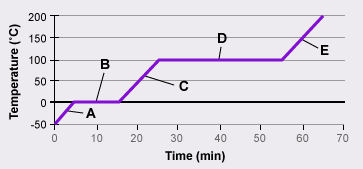
Which state or phase change is represented?Does kinetic or potential energy change?Which specific heat capacity or latent heat is used to find the heat?A
B
C
D
E