Riding the Circular Wave?
Antoine and Adriane choose different Ferris wheels at the amusement park, and each rides for 4 minutes without stopping. Use what you know about sinusoidal graphs and their transformations to model one of their rides. You can use a sinusoidal function to model the height of a rider on a Ferris wheel. Use the information you have about the wheel to come up with transformations that will give you an accurate equation.
Sketching a Graph
1. First, list three things you know about either Antoine's or Adriane's Ferris wheel: its maximum and minimum elevations, and the time it takes to complete one revolution. (1 point)
2. Antoine and Adriane are each at the top of a Ferris wheel. After one revolution, each will again be at the top. Which sinusoid (sine or cosine) should you graph to model the ride of your chosen rider? Why? Assume that each Ferris wheel starts at time = 0 seconds. (2 points)
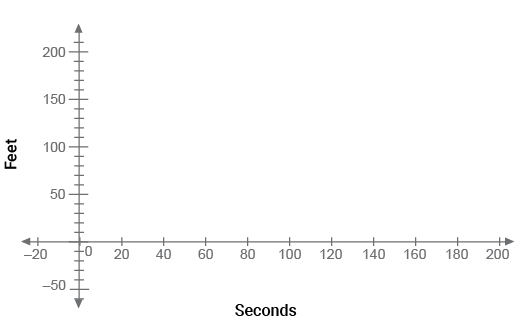
3. On the axes below, sketch two full cycles of your chosen rider's Ferris wheel. (5 points: 1 point each)
- Sketch horizontal lines at the minimum and maximum heights.
- Calculate the midline as the average of the minimum and maximum y-values and sketch it on the graph.
- The period is the time it takes to go one revolution. Complete the box by sketching vertical lines to show the starting and ending points of one cycle.
- Sketch one cycle of the sinusoid inside the box.
- Sketch a second cycle using the same period.
4. Use your graph to answer the questions. (2 points: 1 point each)
a. What is the diameter of your rider's Ferris wheel?
b. How far off the ground is Antoine or Adriane after going one-fourth of the way around?
5. Write an equation for the sinusoid you graphed. (5 points: 1 point each)
a. Identify the amplitude, a.
b. Use the period to calculate b.
c. Identify the phase shift, c.
d. Identify the midline value, d.
e. Write the equation.
Using Your Model
6. How far off the ground is Antoine or Adriane after riding for 15 seconds? Substitute x = 15 into your equation from question 5. (2 points)
7. Use your graph to estimate Antoine's or Adriene's height after riding for 15 seconds. Does this height agree with your answer from question 6? (1 point)
8. How far off the ground is Antoine or Adriane after riding for 4 minutes? Hint: First find the number of seconds in 4 minutes. If you use a calculator, make sure it is in radian mode. (2 points)
Physics
Question 1 (8 points) a. Fill in the blanks in the following paragraph to correctly describe the nucleus of an atom. (2 points)
and
are the two types of nucleons that make up a nucleus. The
force exists between
in the nucleus because of their charge. Because it is repulsive, this force tends to make a nucleus
. However, the
force acts between protons, between neutrons, and between protons and neutrons. This force helps to make a nucleus
, because it is always attractive.
b. How does the total mass before a nuclear reaction compare with the total mass after a nuclear reaction? How does Einstein's equation address this difference? (1 point)
c. Complete the table below to review the main types of radiation. (2 points)
| Radiation | Symbol | Mass | Charge | Penetrating |
|---|---|---|---|---|
| Alpha particle | ||||
| Negative beta particle (electron) | ||||
| Positive beta particle (positron) | ||||
| Gamma ray |
d. Write the symbol for the nucleus that completes each nuclear equation. (1 point each)
i. 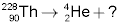
ii. 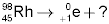
iii. 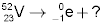
Question 2 (4 points) a. What happens to a radioactive isotope over the course of 1 half-life? (1 point)
b. How does the half-life of an isotope relate to the stability of its nucleus? (1 point)
c. Complete the following table to show how to determine the amounts of parent and daughter nuclei and the time passed with each half-life. (2 points)
| Number of half-lives | Fraction of | Fraction of | Ratio of | Time |
|---|---|---|---|---|
0 | 1 | 0 | 1:0 | 0 |
1 |
| 20 days | ||
2 |
| 1:3 | ||
3 |


Question 3 (3 points) a. Review nuclear fission and nuclear fusion by placing X's in the appropriate boxes. (2 points)
Nuclear | Nuclear | |
Converts matter into energy | ||
Occurs in nuclear power plants | ||
Splits a nucleus | ||
Produces radioactive waste | ||
Uses hydrogen | ||
Occurs in the Sun | ||
Uses uranium | ||
Creates limited fuel | ||
Creates abundant fuel |
b. What conditions are required for nuclear fusion that prevent it from being used to generate electric energy? (1 point)
Question 4 (4 points) a. In quantum mechanics, what does wave-particle duality describe? (1 point)
b. What does the term quantized light mean? (1 point)
c. Fill in the blanks in the following paragraph to correctly identify phenomena that help provide evidence for the particle nature of light. (2 points) A(n) _______________ absorbs energy and then emits electromagnetic radiation based on its _______________. Classical physics predicted that at a high enough temperature, _______________ light would be emitted. Instead, white light was emitted, resulting in the ultraviolet _______________. The photoelectric effect occurs when light shining on a metal creates a(n) _______________. However, only light of a certain minimum _______________ causes electrons to flow. Gas atoms excited by an electric current emit bands of colors of light in a(n) _______________. Each narrow band of light is associated with _______________ of a specific energy.
Question 5 (3 points) a. In what frames of reference does special relativity apply? (1 point)
b. In what frames of reference must general relativity be used? (1 point)
c. Describe what happens to time and length at speeds close to the speed of light. (1 point)
Question 6 (3 points) a. Describe the big bang theory. (1 point)
b. Match each model of the universe with the future it predicts. (1 point) A. Closed B. Flat C. Open _____ The universe will stop expanding but will not collapse. _____ The universe will continue to expand forever. _____ The universe will stop expanding and then collapse back to its point of origin.
c. Match each observation to the conclusion it supports in the big bang theory. (1 point) A. Light from other galaxies is shifted toward the red end of the spectrum. B. Cosmic background radiation appears uniform across the sky. C. The amount of helium in the universe matches predictions. _____ Nucleosynthesis of light elements occurred shortly after the expansion of the original ball of energy. _____ The universe is expanding. _____ The universe began from a single point.