Overview
- Electric Potential
Electric potential is the amount of electric potential energy per unit charge at a point in an electric field. It is a scalar quantity and is measured in volts (V). The potential difference between two points drives charge flow in circuits.
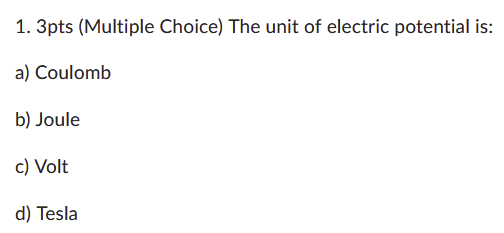
Answer: C ) Volt
2. 5pts (Numerical) A charge of 3uC is moved from a point where the electric potential is 100V to a point where it is 50V. Calculate the work done.
3. 5pts (Short Answer) Explain the relationship between electric potential and electric field.
4. 5pts (Critical Thinking) Why does the electric potential inside a conductor remain constant?
5. 5pts (Essay) Compare and contrast electric potential and electric potential energy.
2. Electric Field and Gauss’s Law
The electric field describes the force per unit charge exerted by an electric charge distribution. Gauss’s Law relates the net electric flux through a closed surface to the enclosed charge.
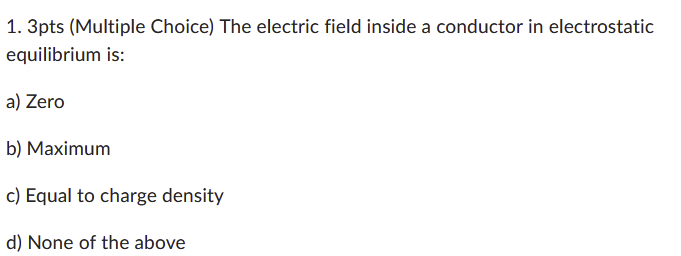
Answer:
2. 5pts (Numerical) A charge of +2.0uC is enclosed in a sphere of radius 0.1 m. Find the electric flux through the sphere using Gauss’s Law.
3. 5pts (Short Answer) What is the significance of Gauss’s Law in calculating electric fields?
4. 5pts (Scenario-Based) A non-conducting spherical shell has charge uniformly distributed on its surface. Describe the electric field inside and outside the shell.
5. 5pts (Essay) Discuss how electric field lines can be used to visualize an electric field and how they relate to the concept of flux.
3. Capacitance and Dielectrics
Capacitance is the ability of a system to store charge per unit voltage. Dielectrics increase capacitance by reducing the electric field within a capacitor.
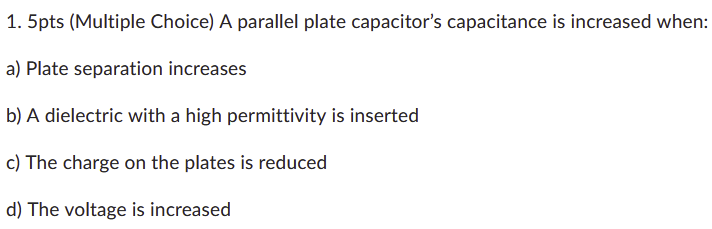
2. 5pts (Numerical) A 5 µF capacitor is connected to a 12V battery. Calculate the charge stored.
4. 5pts (Critical Thinking) How would capacitance be affected if a metal plate were inserted between the plates of a capacitor without touching them?
5. 5pts (Essay) Explain the role of capacitors in electronic circuits and how dielectrics modify their behavior.
4. Current and Resistance
Electric current is the flow of charge, and resistance opposes this flow. Ohm’s Law governs the relationship between voltage, current, and resistance.
Questions
1. 3pts (Multiple Choice) The SI unit of resistance is:
a) Ohm
b) Ampere
c) Coulomb
d) Volt
2. 5pts (Numerical) A resistor of 10 Ω is connected across a 24V battery. Find the current through it.
3. 5pts (Short Answer) Explain how temperature affects resistance in conductors.
4. 5pts (Data Analysis) A material’s resistance decreases with increasing temperature. What does this suggest about its properties?
5. 5pts (Essay) Compare and contrast conductors, insulators, and semiconductors in terms of resistance.
5. Direct Current (DC) Circuits
DC circuits consist of voltage sources, resistors, and capacitors connected in different configurations. Kirchhoff’s Laws help analyze these circuits.
Questions
1. 3pts (Multiple Choice) Kirchhoff’s Voltage Law states that:
a) The sum of currents at a junction is zero
b) The sum of voltages around a closed loop is zero
c) Voltage equals current times resistance
d) Power is conserved in a circuit
2. 5pts(Numerical) In a series circuit with resistors of 5Ω and 10Ω connected to a 15V battery, find the current.
3. 5pts (Short Answer) How does a parallel circuit differ from a series circuit?
4. 5pts (Scenario-Based) If one resistor in a parallel circuit burns out, what happens to the total resistance and current in the circuit?
5. 5pts (Essay) Explain the significance of Kirchhoff’s Laws in circuit analysis with an example.
6. Magnetic Fields and Sources of Magnetic Fields
Magnetic fields arise from moving charges and currents. The Biot-Savart Law and Ampère’s Law describe magnetic field generation.
Questions
1. 3pts (Multiple Choice) The magnetic field inside a solenoid is:
a) Strongest at the ends
b) Uniform and along the axis
c) Zero
d) Radial
2. 5pts (Numerical) A current of 3A flows in a long straight wire. Find the magnetic field 0.05m away from it.
3. 5pts (Short Answer) How does the right-hand rule help determine the direction of the magnetic field around a current-carrying wire?
4. 5pts (Critical Thinking) Why do permanent magnets lose magnetism when heated beyond a certain temperature?
The thermal energy at high temperatures disrupts the alignment of magnetic domains, causing the magnet to lose its magnetism.
5. 5pts (Essay) Compare the Biot-Savart Law and Ampère’s Law in describing magnetic fields.