I'm working on a political science question and need an explanation and answer to help me learn.
To the People of the State of New York:
"THERE is an idea, which is not without its advocates, that a vigorous Executive is inconsistent with the genius of republican government. The enlightened well-wishers to this species of government must at least hope that the supposition is destitute of foundation; since they can never admit its truth, without at the same time admitting the condemnation of their own principles. Energy in the Executive is a leading character in the definition of good government. It is essential to the protection of the community against foreign attacks; it is not less essential to the steady administration of the laws; to the protection of property against those irregular and high-handed combinations which sometimes interrupt the ordinary course of justice; to the security of liberty against the enterprises and assaults of ambition, of faction, and of anarchy. Every man the least conversant in Roman story, knows how often that republic was obliged to take refuge in the absolute power of a single man, under the formidable title of Dictator, as well against the intrigues of ambitious individuals who aspired to the tyranny, and the seditions of whole classes of the community whose conduct threatened the existence of all government, as against the invasions of external enemies who menaced the conquest and destruction of Rome..."- Federalist 70Links to an external site.
Objective:
Explain how presidents have interpreted and justified their use of formal and informal powers.
Knowledge:
Justifications for a single executive are set forth in Federalist No. 70.
TermDefinitionformal powersPowers expressly granted to the president under Article II of the Constitution. Examples include making treaties, commanding the military, appointing Supreme Court justices, and vetoing legislation.informal powersPowers claimed by presidents as necessary in order to execute the law. Examples include issuing executive orders and negotiating executive agreements.single executiveAn executive branch led by a single person.Twenty-second Amendment (1951)The Twenty-second Amendment to the US Constitution applies term limits to the office of the president. Under the Twenty-second Amendment, no one may be elected president more than twice, or serve as president longer than ten years.War Powers Act (1973)Also called the War Powers Resolution, the War Powers Act limits the president’s power to deploy US armed forces. Every president since Nixon has contested the War Powers Act as an infringement of their role as Commander in Chief of the armed forces.
Federalist No. 70 (1788) — “The Executive Department Further Considered,” written by Alexander Hamilton. In this essay, Hamilton argues that a single executive (led by one person as president, rather than several people acting as a council) is the best form for the executive branch of the United States.
He reasons that one president can act more quickly, and with more secrecy when necessary, than a larger group of leaders. He also argues that a single executive is less dangerous to democracy than a council, because it is easier to identify and remove one corrupt person than to discover who among several leaders is a bad actor.
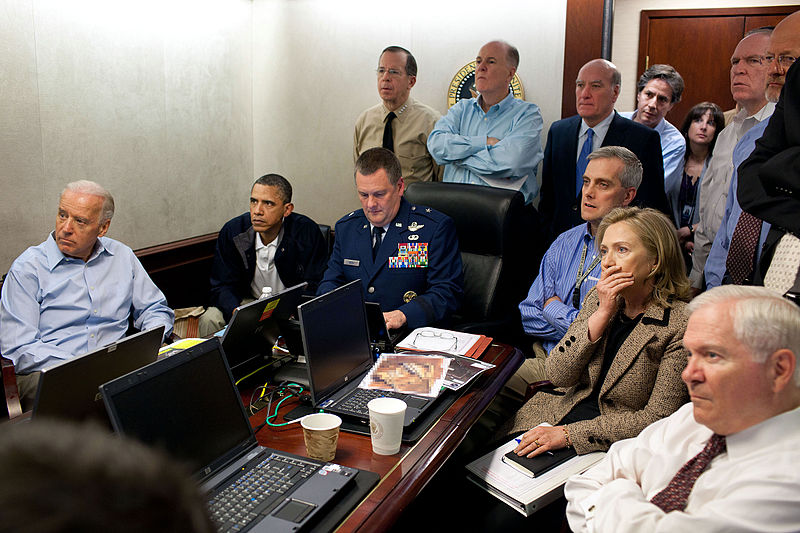
Situation Room- Osama Bin Laden Raid
President Obama- The Single Executive
“Vice President Joe weighed in against the raid”
Vice President Biden was concerned about “the enormous consequences of failure” and counseled that the president “should defer any decision until the intelligence community was more certain that bin Laden was in the compound.”
President Obama, “I appreciated Joe’s willingness to buck the prevailing mood and ask tough questions, often in the interest of giving me the space I needed for my own internal deliberations.”
Defense Secretary Robert Gates, reminded Obama “that no matter how thorough the planning, operations like this could go badly wrong. Beyond the risk to the team, he worried that a failed mission might adversely impact the war in Afghanistan.”
Obama calls that “a sober, well-reasoned assessment”
In the end, it is the swift and individual decision of the Executive.
The Framers and Executive Power Federalist 70Federalist 70 The Founders and the importance of Executive Power How Powerful is the Executive Branch? Executive Power and the Louisiana Purchase Expansion of Presidential Power
Alexander Hamilton-The Federalist Papers
Despite the concepts of a Republic and a Democracy, Hamilton argued for "Energy in the Executive." Reflect on the ideals of the Founders and Hamilton in the construction of the President of the United States, the Executive Officer of the Nation.
See Also: Reconstructive Presidents in C.2.4.3 Discussion-Presidents in Political Time
QuickWrite Questions::
What is Hamilton's objective in Federalist 70?
How have individual presidents leveraged political, economic, social, and/or military events to expand the power of the Presidency over time?